
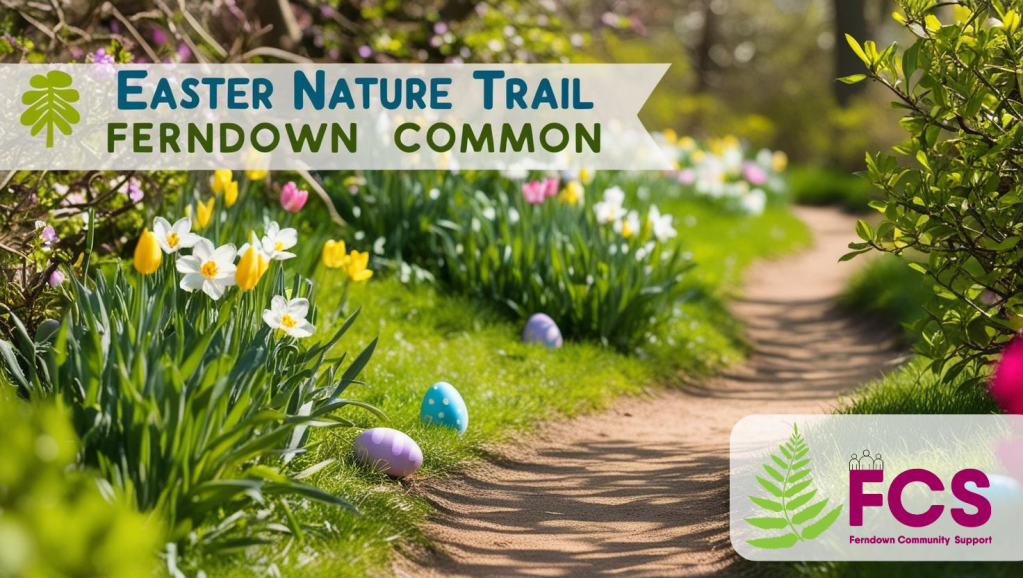
Welcome to our 2025 FCS EASTER NATURE TRAIL, starting Monday 7th April! This year it takes place on Ferndown Common, a 68 hectare internationally important heathland for the wildlife which live there, including all six of the native British reptiles, and Ferndown’s only designated Town Green. Ferndown Common has evidence of Bronze age activity, and also played a part in the D Day preparations of WW2, where Canadian troops allegedly camped across the Common.
Pick up a trail from our friends at Kings Kiosk where you’ll start, or download and print your own below. Follow the trail and answer the questions along the way. When you’ve finished the trail, be sure to pop to Kings Kiosk to pick up an answer sheet, and you’re free badge of completion and colouring sheet! We’d love to see your wonderful colouring in, so please share it on social media and tag us in! Allow 45mins – 1hr to complete the trail. Wear sensible shoes and protect yourself from the sun and rain. You can download a PDF of the route here:
Trail instructions:
You start our trail at Kings Kiosk and the play park. With your back towards the Kiosk and park, turn left and follow the path to the entrance gates.
Q1. Which sport, where players try to roll their ball closest to a small ball, is played on the left behind the hedge?
As you reach the gates, turn right and follow the path along the edge of the playing fields
Q2. Near the pavilion building, you’ll see some large white ‘screens’, which sport are these used for?
In the corner of the upper field, head down the slope to the lower fields and follow the trees down towards the Common entrance
Q3. What is the name of these trees?
At the end of the tree line, head towards the gate entrance to the Common.
Q4. On the entrance gate, you’ll see an information sign. Can you find who looks after the Common? Hint there are 2 organisations!
Go through the kissing gate and take the path straight ahead. You’ll go between lots of yellow flowering spikey plants!
Q5. What is the name of this yellow flowering bush?
Keep straight on, just before the first pine tree there are 2 posts.
Q6. These posts tell you about the activities that are restricted along that path. Write down what these activities are:
Carry straight on until you come to 2 dead trees, also known as ‘snags’
Q7. Lots of creatures call these dead trees home, or use them for food and shelter, but there is one bird in particular who makes their nest in these, can you decide which it is?
- Flamingo
- Sparrowhawk
- Woodpecker
Carry straight on until you come to a fork, take the right hand path. Approximately 20m later you’ll see a post on your left.
Q8. What reptile is illustrated on the sign? Bonus point for the exact name of the reptile!
Keep straight on, you’ll quickly pass several white barked trees on your right
Q9. What are these white barked trees called? Hint S B
Carry straight on the path, until you come an area that has been cleared of vegetation (the bushes and plants). Whilst this looks destructive, clearing the gorse and shrubs is a vital part of managing heathland habitats which are home to some of the rarest bird, reptile and invertebrate species in the UK. Gorse is fast growing and spreads quickly. Without control it will take over heath or grasslands, which means we lose lots of other light-loving plants, birds, animals and insects. Gorse can burn rapidly, making it a fire hazard in dry conditions. Unmanaged blocks of old gorse are a particular wildfire risk, so clearing it in sections helps to create ‘breaks’, so that should a fire happen, it is harder for it to spread as quickly. Gorse also soon becomes ‘leggy’ and straggly, the lower stems losing their wildlife value. But, by clearing sections, it helps stop it spreading and creates bare patches of ground where light-loving insects, reptiles and birds can thrive. The new growth that follows the burning is an excellent food source for wildlife and its denseness favours nesting birds and insects.
Keep to the left as you walk through the clearing, and past a post with arrows showing you the way.
Q10. What colour are the arrows on the post?
Once you have branched left past this post, continue on. Along the way, the eagle eyed amongst you will have spotted lots of pine cones! Pine cones are the fruit of pine trees, and each cone contains lots of seeds that can make a new baby pine tree.
Q11. How many seeds are in the average pine cone?
Along this stretch you’ll also see that someone has sadly lit a fire and left the area scorched with no plants or animals. They were very lucky that this didn’t spread and cause a big fire that would kill and injure lots and lots of wildlife, as well as being really dangerous for people and their homes nearby. We must all be safe and considerate, never light fires in the countryside or use BBQ’s unless permitted.
Just after a left hand turn (don’t take this), on your right you’ll see a large prickly shrub. This bush is often used at Christmas to make wreaths, as well as a popular drawing on Christmas cards.
Q12. What is this bush called and what colour are its berries?
Keep following the path.
Q13. Whilst you’re walking, have a think about why its important to stick to the paths, especially at this time of year. What else might be around on the ground?
When you get to the T junction, turn left, heading towards the house that appears in view as you walk. Keep going until you come to a signpost.
Q14. What is the name of the road on the signpost?
Turn left (from where you’ve come from, not towards the road), as you come out from the trees to the more open area, you will see a home in the distance on your right
Q15. What do you call the white framed room on the home?
When you have reached the T junction follow the blue arrow to the right until you reach the noticeboard which tells you all about the heathland and its important plants and animals.
Q16. What insect eating plant grows in the heath?
Q17. What reptile uses sand as its nest?
Once you’ve read about some of the precious plants, insects and animals of the heathland (hint, if you got stuck on Q13, you’ll find the answer here too!), bear left following the edge of the playing field. You’ll soon come to the kissing gate entrance.
Congratulations – you’ve finished the trail! Head back across the playing fields and be sure to pop to Kings Kiosk to pick up an answer sheet, and your free badge of completion and colouring sheet!
Hope you enjoyed the trail and safe journey home. Or why not stay and enjoy the play park, take a ball to play with on the fields, pack a picnic to enjoy, or grab a drink and snack from Kings Kiosk. You can pick up an answer sheet and your badge of completion and colouring sheet from kings Kiosk too!
When?
Throughout the Easter holidays, beginning Monday 7th April. Go when it suits you!
How much
FREE!
Where?
Ferndown Common, start at Kings Kiosk, King George V Field, Peter Grant Way, BH22 9EN. What 3 words: ///coherent.soon.deeply
Can I find out the answers after I’ve completed the trail?
Yes! Pop to our friends at Kings Kiosk to collect an answer sheet and a free badge of completion!

